 BALL AI
Beginners don't need 40 drills. They need five skills, learned in the right order, until each one feels easy.
This page is the checklist. Each skill has what good looks like and a quick test you can run in the driveway. When your kid passes the test, they're ready for the next step.
The order matters
Coaches who work with first-year players tend to teach the same way: move first, then control the ball, then score close, then add passing and the game. Fancy moves come later.
Here's the order:
- Stance and footwork
- Dribbling with both hands
- Form shooting close to the rim
- The layup
- Passing and catching
Work on two at a time, not all five. Most beginners spend weeks to months on this list. That's normal.
Skill 1: Stance and footwork
Why first: Every other skill starts from balance. A kid who can stop and pivot without traveling looks ready on day one of practice.
What good looks like:
- Feet about shoulder width, knees bent, back mostly straight.
- A two-foot jump stop that lands quiet and balanced.
- Pivoting on one foot without the pivot foot sliding.
- Triple threat after a catch: ball at the hip, ready to shoot, pass or dribble.
The test: Jog, jump stop on your call, then pivot a full circle each way. Five in a row with no wobble and no travel = pass.
Skill 2: Dribbling with both hands
Why second: At the youth level, kids who can dribble get the ball more and keep it.
What good looks like:
- Fingertips, not the palm.
- Ball at hip height or lower.
- Eyes up, not on the ball.
- The weak hand works too, even if it's slower.
The test: 30 seconds per hand, stationary, eyes up (hold up fingers and have them call out the number). No lost balls on the strong hand and two or fewer on the weak hand = pass. Then try it walking.
Skill 3: Form shooting close to the rim
Why third: Good habits start close. Shooting from too far teaches a heave, and the heave sticks.
What good looks like:
- Elbow under the ball, guide hand on the side.
- Eyes on the rim the whole time.
- Legs bend and push, not just arms.
- Follow through: wrist relaxed, fingers pointing at the rim.
The test: One step from the rim, straight on. Ten shots with the same form every time. Makes matter less than form. If the form holds on most of them, move back a step.
Ball size makes a big difference here. A ball that's too big turns every shot into a two-handed push. Sizes by age are in our basketball gift guide.
Skill 4: The layup
Why fourth: It's the highest-percentage shot in the game, and it ties footwork, dribbling and shooting together.
What good looks like:
- Right-hand layup: jump off the left foot. Left-hand layup: jump off the right foot.
- Knee on the shooting side drives up.
- Ball goes off the backboard, top corner of the square.
The test: Start with no dribble, one step. Then two steps. Then one dribble in. Five clean right-hand layups with the right footwork = pass. The left side can come a few weeks later.
Skill 5: Passing and catching
Why fifth: Beginners who can catch and pass get included in the game. That keeps them coming back.
What good looks like:
- Chest pass and bounce pass with thumbs behind the ball.
- Step toward the target.
- Catch with two hands, then land in triple threat (Skill 1).
The test: Ten chest passes and ten bounce passes with a parent from about 10 feet. Most hit your chest, or bounce about two-thirds of the way to you = pass.
What to skip for now
- Behind-the-back and between-the-legs moves.
- Three-pointers and long shots.
- Set plays, screens and zone defense.
All of these come easier once the five basics feel automatic.
How parents can help
- One cue at a time. "Eyes up" for dribbling. "Elbow in" for shooting. Not both.
- Short sessions. 15 to 20 minutes, four or five days a week, beats one long weekend session.
- Track one number. Dribbles in 30 seconds, or makes out of ten from one step. Write it down. Seeing the number climb over a few weeks is what keeps kids going.
- End on a make. Always.
Where Ball AI fits
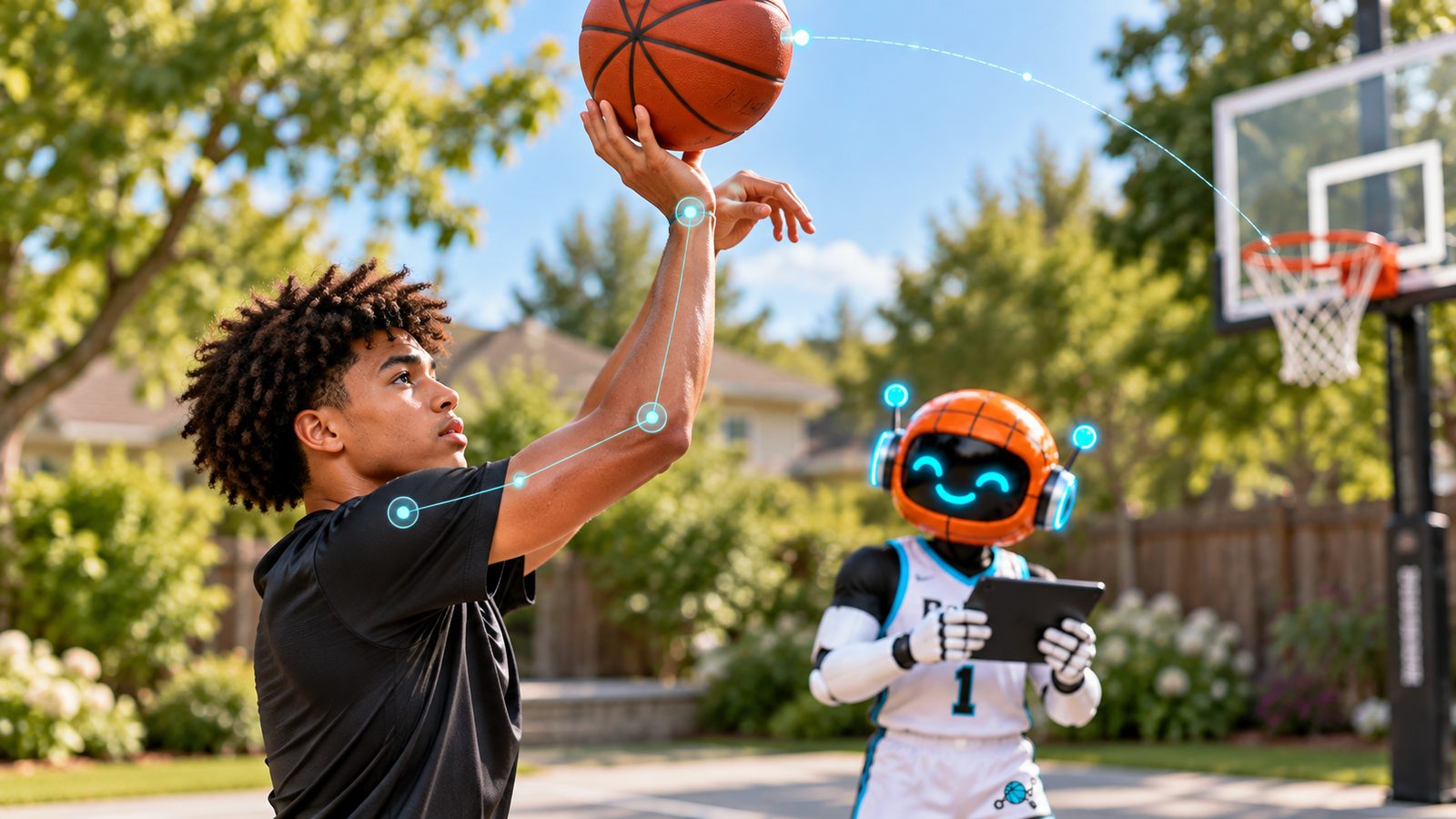
If you want help keeping count, Ball AI is an AI basketball coach on the phone camera. It tracks shots and dribbles during practice, so your kid sees their numbers without you holding a clipboard. It sits next to a team or a coach. It doesn't replace either. More on picking an app for a first-year player in our guide to the best basketball app for beginners.
FAQ
What basketball skills should a beginner learn first?
Stance and footwork, then dribbling with both hands, then form shooting close to the rim, then the layup, then passing and catching. Work on two at a time.
How long does it take a beginner to learn basketball basics?
It depends on the kid and how often they practice. Most beginners need weeks to months of short, regular sessions before the basics feel automatic.
Should my kid practice with their weak hand?
Yes, from the start. It will feel slower. A few minutes a day on the weak hand adds up.
How do I know my kid is ready for harder drills?
Use the test for each skill. When they pass a skill's test on two different days, add the next skill or a harder version.
Can my kid learn basketball skills at home?
Yes. Dribbling, footwork and passing need only a ball and a flat space. Shooting and layups need a hoop at the right height. See our drills for kids at home.